

A stablecoin is a crypto token built to hold a fixed value, almost always one US dollar, so that one token is meant to be worth one dollar at all times. It exists to bring price stability to a market where everything else moves. You can hold it, send it, or trade with it the way you would use cash, without watching the value swing the way Bitcoin or Ether do. That is the whole point of the design.
Here is the part most pages skip. Stability is the goal, not a promise. A stablecoin holds its peg only as long as the thing behind it holds up, and a few have failed badly enough to wipe out tens of billions of dollars in a week. Most of the time they work. The job of this page is to show you how they work, what can break them, and how to judge a single coin before you trust it with real money.
- A stablecoin is a crypto token engineered to track an outside asset, almost always the US dollar. "Stable" describes the design, not a guarantee.
- Most large stablecoins are fiat-backed: a company holds reserves and promises you can redeem one token for one dollar. The peg holds through that promise plus trader arbitrage.
- The four types are fiat-backed, commodity-backed, crypto-backed, and algorithmic. Each carries a different risk.
- USDT has the widest reach across exchanges; USDC built its name on a more conservative, US-regulated posture. Neither is risk-free.
- There is no FDIC insurance on a stablecoin. If the issuer fails or the reserves fall short, no government makes you whole.
- XRP is not a stablecoin. Its price floats. Ripple's actual dollar-pegged token is a separate coin called RLUSD.
How does a stablecoin hold its peg?
A stablecoin holds its peg through a mix of backing and arbitrage, and the design of that mix is the single most important thing about any given coin. There are three core mechanisms. Understand them and you understand almost everything about how a coin behaves when markets get rough, which is exactly when you find out whether a peg was real.
Fiat-backed coins hold the peg with reserves and redemption. This is the simplest model and the one behind the largest stablecoins on the market. The issuer takes a real dollar, holds it, or holds something close to a dollar like a short-term US Treasury bill, and issues one token against it. The promise is that you can always redeem one token for one dollar. That promise is what keeps the market price near a dollar, through a process called arbitrage.
Arbitrage sounds technical, so here is the plain version. Picture a coin trading at 99 cents on an exchange while the issuer still honors redemptions at a full dollar. A trader can buy the cheap token, redeem it with the issuer for a dollar, and pocket the penny. That buying pushes the price back up toward a dollar. If the token climbs above a dollar instead, the reverse happens: people mint new tokens for a dollar each and sell them into the higher price until it settles back. The peg, then, rests on two things. Are the reserves really there. And does redemption actually work when everyone wants out at once. When either is in doubt, the arbitrage stops, and the price drifts away from a dollar.
Crypto-backed coins hold the peg with overcollateralization. Some stablecoins are backed not by dollars in a bank but by other crypto locked in a smart contract. DAI is the best-known example, running on Ethereum. Because crypto prices swing hard, you cannot back a dollar of stablecoin with exactly a dollar of volatile collateral. One bad day and the backing falls underwater. So these systems demand more collateral than the coins they issue. To create a dollar of the stablecoin, you lock well over a dollar of crypto, often half again as much or more. If your collateral's value drops toward a danger line, the system sells it automatically to keep the coin fully backed.
The trade-off is what crypto people call capital efficiency: you tie up more value than you get out, so the model is expensive to use. The benefit is transparency. Anyone can check the collateral on-chain rather than trusting a private company's word about what sits in a bank account. You are swapping one kind of trust for another: trust in code and live market prices instead of trust in a corporate balance sheet.
Algorithmic coins try to hold the peg with code and incentives, and this is where the bodies are buried. A purely algorithmic stablecoin is not backed dollar-for-dollar by anything outside the system. Instead it uses a paired token and a mint-and-burn rule to nudge the price toward a dollar. The most infamous example was TerraUSD, known as UST, paired with a token called LUNA. The rule was simple: you could always swap one UST for a dollar's worth of LUNA, and the other way around. If UST fell below a dollar, you were meant to burn it for LUNA at a profit, shrinking the UST supply until the price recovered. On paper, elegant. In practice, it held a fatal loop, and in May 2022 that loop ran in reverse.
I will go into the full collapse in the safety section below, because it is the clearest lesson in this whole topic. For now, the headline is this. A peg with no hard asset behind it is a confidence trick that works right up until confidence runs out, and confidence runs out fast.
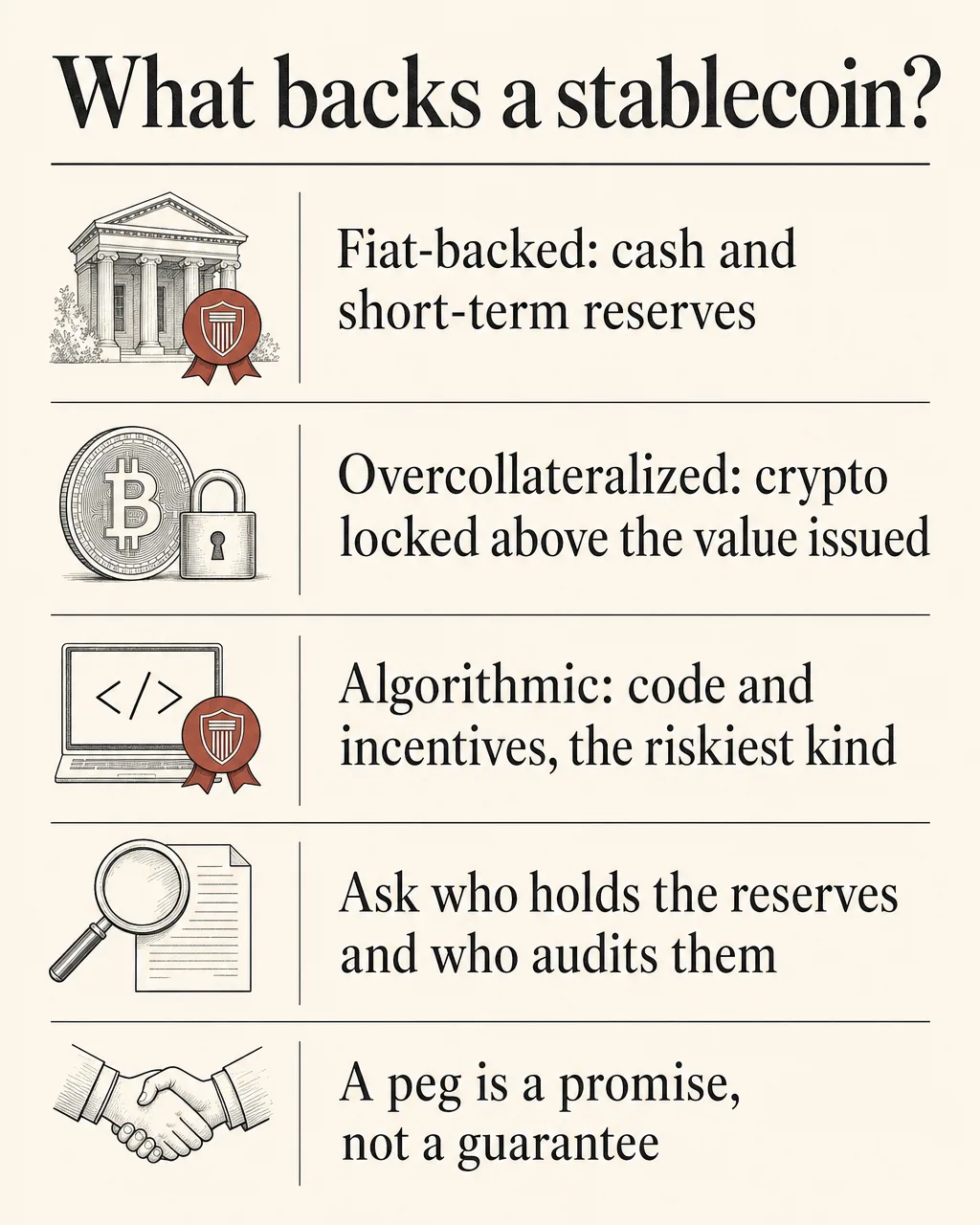
What is a stablecoin, and what are the four types?
A stablecoin is a crypto token engineered to track the price of an outside asset, and the four types differ by what backs the token. Knowing which type a coin is tells you what can go wrong with it, which is the only reason the categories matter. Here they are, each with one example and its main risk.
Fiat-backed stablecoins are backed by cash and cash-like reserves held by a company. The two largest dollar stablecoins, USDT and USDC, are both this type. The main risk is counterparty risk: you are trusting that the issuer actually holds the reserves it claims, manages them carefully, and will honor redemptions under stress. The quality of those reserves is not all equal, a point worth its own section below.
Commodity-backed stablecoins track the price of a physical asset rather than a currency, most often gold. One token stands for a claim on a set amount of metal held in a vault. The risk blends counterparty risk, meaning does the gold exist, is it audited, can you actually claim it, with the plain fact that the asset's own price moves. A gold-backed token is stable against gold, not against the dollar, so it is not the kind of coin you reach for when you want a steady dollar value.
Crypto-backed stablecoins, like DAI, are backed by overcollateralized crypto in smart contracts. The risk is that a sharp, fast crash in the collateral can outrun the system's ability to sell it in time, leaving the coin under-backed. These coins also carry smart-contract risk: a bug in the code that holds everything together can be exploited, and on a public blockchain that exploit is often irreversible.
Algorithmic stablecoins try to hold value through supply-adjusting code and a paired token, with little or no outside backing. UST was this type. The risk is the one its collapse made famous: when faith fails, the mechanism meant to defend the peg accelerates its destruction instead. Treat any coin in this category as the highest-risk corner of an already risky space.
The split that matters most for a newcomer is fiat-backed versus algorithmic, because it is the difference between a coin backed by something you can point to and a coin backed by a clever idea.
- A real asset sits behind every token, so the peg has a floor to stand on
- You can usually redeem with the issuer for a dollar, which arbitrage relies on
- The largest, most liquid stablecoins are this type, so they are easy to trade
- Reserve reports and attestations give you something concrete to check
- You depend on a private company holding and managing the reserves honestly
- Reserve quality varies, and slower or riskier assets can fail you in a crisis
- The issuer can freeze or block addresses, since it controls the rails
- A redemption freeze under stress can still knock the price off the peg
Fiat-backed coins are the safer end of the spectrum, but "safer" is not "safe," and the cons column is the reason. Algorithmic coins, by contrast, sit at the other end. They promise capital efficiency and decentralization, and they have a track record of going to zero. For someone new to crypto, the lesson is plain: know which type you are holding before you hold it.
USDT vs USDC: which should you use?
For everyday use on exchanges and across the widest range of chains, USDT has the broadest reach; for someone who wants a more conservative, US-regulated issuer with clearer reporting, USDC is the common pick. Both are fiat-backed dollar stablecoins, both are among the largest in the market, and both have generally traded close to a dollar. The differences come down to who runs them and how each handles reserves and oversight.
| Factor | USDT (Tether) | USDC (Circle) |
|---|---|---|
| Issuer | Tether | Circle |
| Backing model | Fiat-backed reserves | Fiat-backed reserves |
| Where it is used most | Widest exchange and chain support; heavy in global and offshore trading | Strong on US-based platforms, including Coinbase, and in on-chain finance |
| Reserve transparency | Publishes reserve breakdowns and attestations; check the issuer's transparency page for current detail | Publishes regular reserve reports; check the issuer's transparency page for current detail |
| Regulatory standing | EU rules have affected which venues there will list it; check current exchange policies | Has pursued US regulatory alignment; check current status under evolving US rules |
| Typical use | The default unit of trade across much of the market | Preferred where US compliance and clearer reporting matter |
The honest summary: USDT wins on sheer availability and is the default unit of trade across much of the market, while USDC has built its reputation on a more conservative, US-regulated posture and clearer reporting. If you trade on global exchanges and want the deepest liquidity and the widest pairs, you will meet USDT first and most often. If you sit mostly on US platforms and care about a regulated issuer that reports its reserves on a regular cadence, USDC is the natural choice.
Neither is risk-free, and this is the part to keep in mind. Both depend on a private company holding real reserves and honoring redemptions on demand. That dependency is exactly what you are accepting when you hold either one, and it is the same dependency, whichever logo is on the token. Picking between them is choosing your trade-off between reach and reporting, not choosing between risk and safety.
Are stablecoins safe? The honest answer
Stablecoins are safer than holding volatile crypto, but they are not as safe as money in a bank, and treating one like a savings account is the mistake that costs people. A stablecoin can lose its peg, and when it does you can lose part or all of your money with no one obligated to make you whole. That sentence is the whole safety lesson, and everything below explains why it is true.
There is no FDIC insurance on a stablecoin balance. A bank deposit in the US is insured up to a legal limit if the bank fails. A stablecoin is not a deposit and carries no such protection. If the issuer fails, or the reserves turn out to be less or worse than claimed, your recourse is limited and slow. Do not treat a stablecoin as a checking account or an insured savings account, because it is neither.
There are three main ways a stablecoin breaks, and they map onto the mechanisms covered above.
The first is reserve failure: the issuer does not hold what it says it holds, or the reserves are tied up in assets it cannot sell fast enough when redemptions surge. This is the core risk for fiat-backed coins, and it is quieter than the others, because the problem is invisible until the day everyone asks for their dollars at once.
The second is a redemption freeze or a bank run: even with good reserves, if too many holders demand dollars at the same moment and the issuer cannot process redemptions quickly, panic feeds on itself and the market price drops below a dollar. A peg is partly a psychological thing. Once a crowd doubts it, the doubt becomes the cause.
The third is mechanism collapse, the algorithmic failure UST showed the whole market, where the design meant to defend the peg becomes the engine that destroys it.
What happened to TerraUSD
What happened to TerraUSD is the case study that should anchor your caution, so here is the death spiral in plain English. UST's peg held in part because a lending platform called Anchor paid an unusually high yield on UST deposits, which drew in heavy demand to hold the coin. That yield was the lure, and a yield that high is rarely free.
When confidence cracked and large holders started selling UST, the price slipped below a dollar. People rushed to swap UST for LUNA to escape, which minted enormous new amounts of LUNA. That flood of new LUNA crushed LUNA's price. But the system still valued each fleeing UST at "a dollar's worth of LUNA," so as LUNA fell, it took ever more LUNA to honor each swap, minting still more, crashing it further. Falling LUNA broke confidence in UST, more holders fled, more LUNA was minted, and the two tokens dragged each other to near zero within days. There was no pile of real dollars to redeem against and no floor to stop the fall.
UST was not a small, obscure coin. It was one of the largest stablecoins in the market right up until the week it went to near zero, and it took faith, savings, and a slice of the wider crypto market down with it. The lesson is not that every stablecoin is doomed. It is that the label "stablecoin" promises nothing on its own. The design and the backing are everything, and a high advertised yield is a reason to look harder, not a reason to relax.
Why reserve quality is the thing to judge
This is why reserve quality is worth more than a green checkmark on a marketing page. "Backed one-to-one" is not a single thing. There is a spectrum, and the order on it matters most exactly when a crisis hits. Cash in an account is the most reliable backing, ready to pay out at full value on demand. Short-term US Treasury bills are close behind, since they are easy to sell quickly for close to full value. Further down sit assets like commercial paper, which can be harder to sell fast and at full price in a panic. At the riskier end is crypto collateral, whose value can fall at the worst possible moment, the same moment redemptions spike.
Two coins can both claim full backing while holding completely different reserves, and the one packed with slower, riskier assets is the one more likely to wobble when everyone heads for the door at once. When you judge a stablecoin's safety, you are really judging what its reserves are made of and how fast they can become real dollars. A coin that holds cash and short-term Treasuries and reports them clearly is a different animal from one that is vague about what stands behind it.
One honest caveat, the kind I always add. Knowing the reserve mix protects you from the issuer's balance sheet, not from your own mistakes. If you hold a stablecoin in your own wallet, the usual rules of crypto still apply: lose your keys and the coin is gone, no matter how solid the reserves. If you are deciding where to keep yours, it helps to understand what a crypto wallet is and who controls the keys before you move anything. Broader crypto safety habits matter here as much as anywhere, because a perfectly backed stablecoin sent to the wrong address is just as lost as one whose issuer failed.
How much is in circulation, and why does it matter?
The total amount of stablecoins in circulation is one of the most watched numbers in crypto, because it works as a rough gauge of how much real money is sitting on crypto rails ready to move. When the total supply grows, it often signals fresh money entering the market. When it shrinks, money may be heading for the exits. Traders read these inflows and outflows as a sentiment signal, a sense of whether capital is arriving or leaving, in the way a retailer reads foot traffic before it reads the till.
It helps to keep the scale honest. The total stablecoin supply is large in crypto terms, but it is small next to the broad money supply of a national economy, the measure economists call M2. Stablecoins are a meaningful and growing slice of the financial system's plumbing, not a replacement for it, and any claim that they have eclipsed the dollar should set off your skeptic's alarm. For live figures, on-chain trackers update constantly, and any supply number is only true on the day you read it, so date-check anything you see quoted.
Within that total, the market is concentrated. A small number of coins, led by USDT, hold the large majority of all stablecoin value, with USDC the major second. That concentration cuts both ways. It means the biggest coins are deeply liquid and easy to trade, which is good for anyone who just wants to move in and out cleanly. It also means a problem at one large issuer would ripple far past its own holders, the same way trouble at one big bank rattles the whole street. This is why a brief loss of the USDC peg in early 2023, when some of its reserves were briefly stuck at a failed bank, briefly shook the entire market before redemptions were honored and the price recovered. Size is liquidity and size is contagion risk, both at once.
If you read crypto headlines, you will see stablecoin flows tracked alongside crypto ETF flows as twin gauges of where money is moving. They measure different pipes, but the instinct is the same: watch the money, not the mood.
What do the GENIUS Act and MiCA mean for you?
Stablecoins are moving from a lightly governed corner of crypto into a regulated one, and the two rule sets you will hear about most are the GENIUS Act in the United States and MiCA in the European Union. Both aim at the same basic goal: forcing issuers to back their coins with solid reserves, be transparent about what those reserves are, and meet standards before they can serve users in those markets. For an ordinary holder, the direction of travel is toward clearer rules on who can issue a stablecoin and what has to sit behind it.
The practical effects are still settling, and they differ by region. In the EU, MiCA sets conditions that have already shaped which stablecoins exchanges there will list and offer to European users; some coins have been delisted or restricted on EU venues to comply. In the US, the GENIUS Act sets a framework for how dollar stablecoins are issued and overseen. The specifics are exactly the kind of detail that changes, so check current sources rather than trusting a figure or a rule that may be stale by the time you read it.
What this means for you is straightforward. Regulation makes the safest stablecoins a little safer and a little more boring, which on a finance site counts as a compliment, because boring is what you want from a thing that is supposed to hold one dollar. It also means the rules around which coins you can buy, and from whom, will keep shifting, and a coin available in one country may be off-limits in another. The same instinct that protects you elsewhere applies here: understand what backs the coin, know who stands behind it, and do not assume a token holding a dollar today is guaranteed to hold one tomorrow. If you are still working out how to buy crypto in the first place, start there before committing any money to a stablecoin.
Is XRP a stablecoin?
No, XRP is not a stablecoin. Its price floats on the open market and swings with supply, demand, and sentiment like any other speculative crypto asset, which is the opposite of what a stablecoin is built to do. I put this question late on purpose, because by now you can see exactly why XRP does not fit: nothing pins it to a dollar, and no reserve or mechanism is trying to.
People confuse the two for a couple of understandable reasons, and it is worth naming them rather than waving the question away. XRP is often described as a "bridge asset" for moving value between currencies on Ripple's network, and "bridge between dollars and euros" sounds adjacent to "tracks the dollar." It is not the same thing. A bridge asset can be worth anything from cents to dollars and back; its job is to be exchanged quickly through, not to stay pinned to a price. You hold it for a moment in a transfer, not as a steady store of a dollar.
The second reason is brand blur. Ripple, the company most associated with XRP, launched its own actual stablecoin, a dollar-pegged token called RLUSD. So within the same corporate family you have a floating asset, XRP, and a stablecoin, RLUSD, which is easy to mix up if you only half-read the news. RLUSD is the stablecoin in that family. XRP is not, and the two are different instruments with different risk profiles. If you want a steady dollar value, XRP is the wrong tool, the same way you would not use a Bitcoin balance to hold a fixed dollar amount.
The short version, the one to remember: a stablecoin is designed to stop moving against the dollar. XRP is designed to be traded. Anything whose whole appeal is that it might go up is, by definition, not built to stay flat.